Whether you are a seasoned flipper or a first-time investor, the term “off-market” probably sounds like music to your ears. It promises deep discounts, less competition, and the kind of margins you simply can’t find on the MLS.
But as the saying goes, “There is no such thing as a free lunch.” Buying off-market properties requires a different mindset, a faster pace, and a specific set of rules.
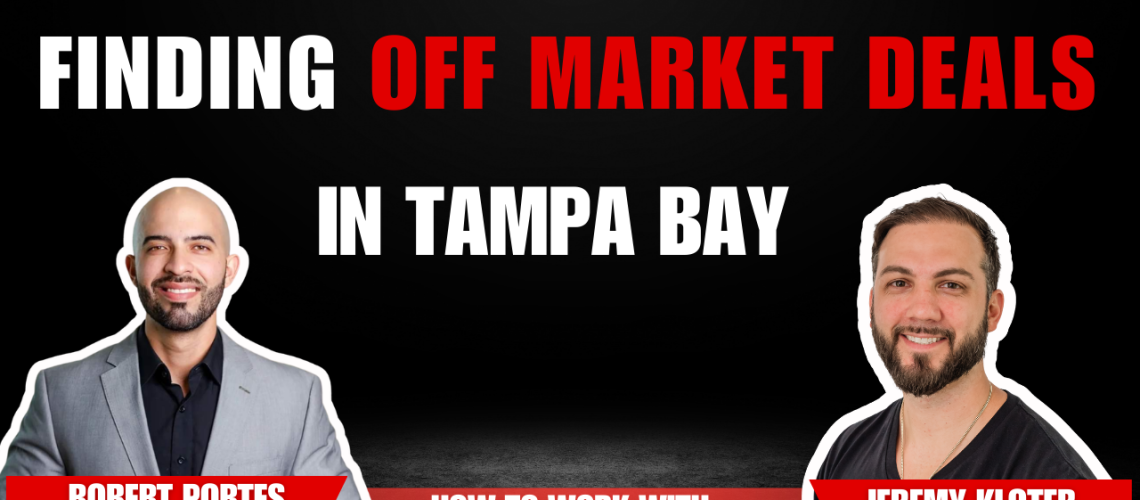
In a recent episode of the Tampa Bay Veteran Investor Podcast, host Jeremy Kloter sat down with Robert Portes, owner of True Homes, to pull back the curtain on how a professional wholesaling operation really works. Robert’s team spends upwards of $50,000 a month on marketing to find these “hidden gems.”
If you want to be the buyer who actually gets the call when a great deal lands, here is what you need to know.
Watch the full video
What Does “Off-Market” Really Mean?
Most people associate real estate with the Multiple Listing Service (MLS). These are properties listed by agents, open to the public, and usually priced at retail value.
An off-market deal is a property sold directly from a homeowner to an investor without being listed publicly. These sellers are often “distressed,” but that doesn’t always mean the house is falling down. Distress can be:
-
Financial: Foreclosure, tax liens, or mounting medical bills.
-
Physical: A leaky roof that prevents traditional bank financing or storm damage (like the flooded homes Robert’s team often handles).
-
Situational: Inheriting a “hoarder house” through probate or needing to move out of state in 14 days.
3 Key Differences Between the MLS and Wholesalers
If you try to buy a wholesale deal using the same timeline as a traditional retail purchase, you will lose every time. Robert highlights three major differences:
1. The “Zero-Day” Inspection Period
On the MLS, you might have 10 to 15 days to bring in an inspector and decide if you want the house. With a wholesaler like True Homes, the inspection period is often zero days.
“We do zero days inspection because we want to make sure you went to see the house, walked it, and you’re ready to move forward,” Robert explains.
Wholesalers are under a tight contract with the seller. They don’t have time for you to “think about it” for a week. You need to have your contractor or your own expertise ready to make a “Yes/No” decision on the spot.
2. Hard Earnest Money Deposits (EMD)
When you sign an assignment contract with a wholesaler, your deposit (usually $5,000 to $10,000) goes non-refundable immediately. This “hard money” ensures you aren’t a “fake wholesaler” trying to find another buyer, but a legitimate investor ready to close.
3. As-Is Means As-Is
Wholesalers don’t ask sellers to fix the sink or paint the shutters. You are buying the property exactly as it sits—trash, smell, and leaky roof included.
How to Get on the “List Before the List”
Robert mentions that his best deals often sell within 20 minutes of being found—sometimes before they are even emailed out to his main list. How do you become one of those “preferred buyers”?
Define Your “Buy Box”
Don’t tell a wholesaler you want “any good deal.” That’s too vague. Give them a specific criteria:
-
Geography: “I only want block homes in zip codes 33607 or 33701.”
-
Condition: “I’m looking for full gut-renovations, not just cosmetic flips.”
-
Budget: “My max purchase price is $250,000 with a $100,000 rehab budget.”
Be Decisive
Wholesalers value certainty over the highest price. Robert shares that he often turns down higher offers to work with a repeat buyer who he knows will close without drama. If you perform well on your first deal, you move to the top of the call list for the next one.
The Economics of a Wholesale Fee
A common frustration for new investors is seeing a wholesaler make a $10,000 or $20,000 assignment fee. It can feel like they are “stealing” equity. However, Robert provides a reality check on the overhead involved in finding these deals:
-
Marketing Spend: $40,000–$50,000 per month.
-
Lead Channels: Google Ads (PPC), Cold Calling, and Pay-Per-Lead (PPL).
-
Staffing: A team of 17 employees including acquisitions, dispositions, and transaction coordinators.
When you buy from a professional wholesaler, you aren’t just buying a house; you are paying for the thousands of hours and dollars they spent filtering out 1,000 “no’s” to find that one “yes.”
Beyond the Flip: Creative Strategies (Novations)
Sometimes a house is too nice for a flipper but the seller still needs a “hassle-free” exit. Robert uses a strategy called a Novation. In a Novation, the wholesaler partners with the seller to list the property on the MLS for a retail buyer. The wholesaler handles the marketing, minor repairs, and negotiations, ensuring the seller “nets” a specific guaranteed number while the wholesaler keeps the spread. This is a win-win for sellers who have a clean house but don’t want the stress of a traditional listing.
The Importance of an Investor-Friendly Title Company
Not all title companies are created equal. If you take a wholesale deal to a big-name retail title company, they might get confused by “assignment fees” or “double closings.” Robert and Jeremy emphasize using a local, investor-focused title company. They understand how to clear “hairy” title issues like probate, code enforcement liens, and multiple heirs. They keep the transaction moving when a standard company would let it stall.
Final Thoughts: Don’t Let One Bad Deal Take You Out
Real estate is a powerful wealth-building tool, but it’s not a hobby. As Robert warns, one bad deal with a poorly calculated renovation budget can take an investor out of the game forever.
Your Action Plan:
-
Vet your wholesaler: Ask if they are “Direct to Seller” (meaning they hold the actual contract).
-
Verify the numbers: Never rely solely on a wholesaler’s ARV (After Repair Value). Run your own comps.
-
Build the relationship: Be the buyer who communicates quickly and closes on time.